
⚡ Key Engineering Takeaways (Quick Summary)
- Precise first-layer pre-tamping force control (typically 2-5 kN) to prevent air entrapment while allowing layer bonding.
- Zero-clearance scraper blade design and dedicated powder extraction shrouds to prevent color cross-contamination.
- Optimized dwell time and lower punch pull-down cam profiles across high-speed dual rotary turrets.
- Troubleshooting layer delamination through punch tip relief angles and controlled compression profile staging.
Compatible Global OEM Machinery Platforms
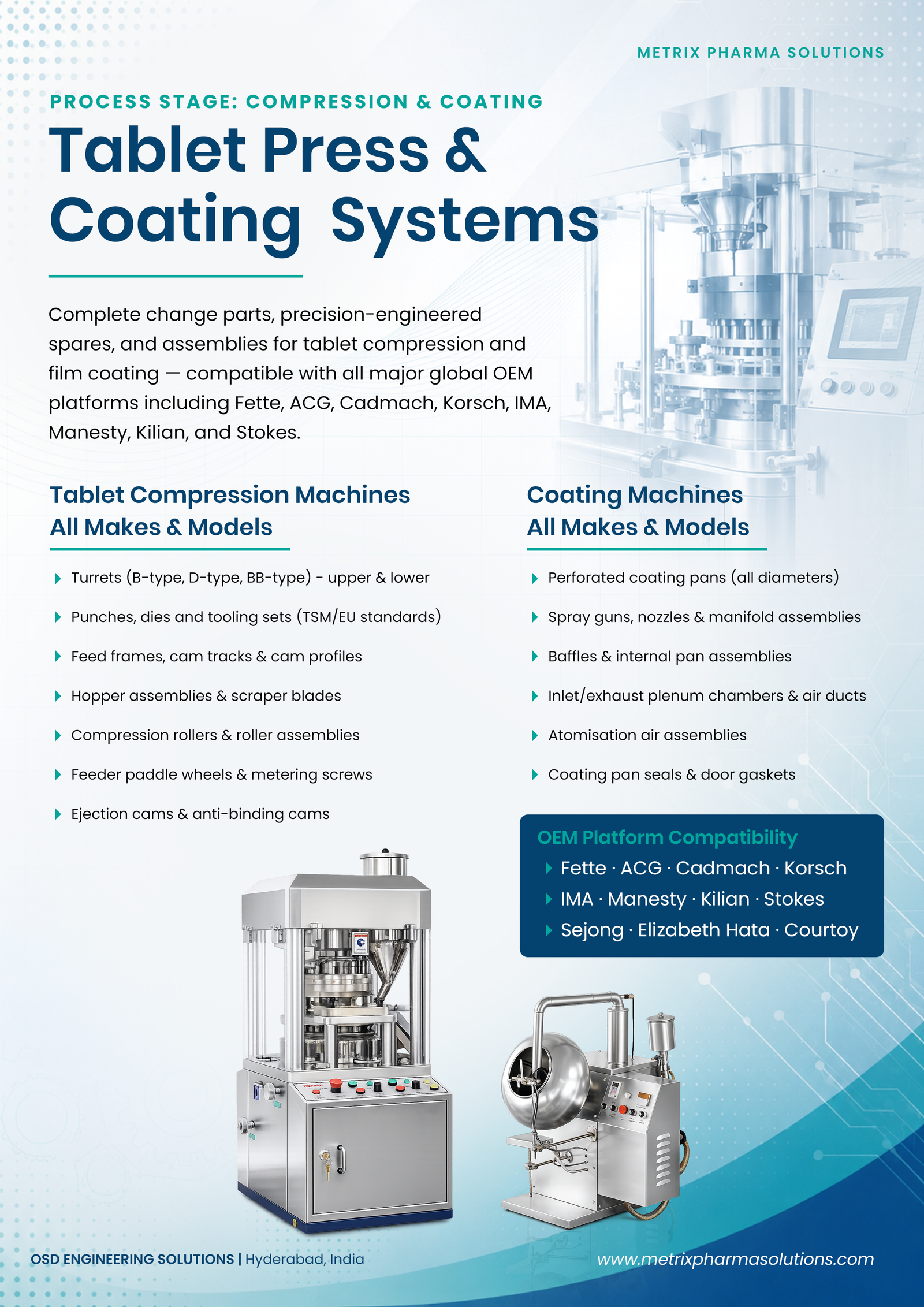
Metrix manufactures direct drop-in replacement components and rebuild kits compatible with:
1. Bilayer Tablet Compression Dynamics & Pre-Compression Balancing
Bilayer tablets combine two incompatible active pharmaceutical ingredients (APIs) or deliver dual-release profiles (immediate-release + sustained-release) in a single convenient dosage form. However, bilayer compression presents significant engineering challenges: layer separation (delamination), layer cross-contamination, and individual layer weight control.
The operation requires specialized double rotary tablet compression presses equipped with two discrete feeding stations and dual compression zones:
- Station 1 (First Layer Tamping): The first formulation is dosed and subjected to light tamping force (typically 2 kN to 5 kN). It is critical NOT to over-compress the first layer, as retaining open surface porosity is essential for physical mechanical interlocking when the second layer is applied.
- Station 2 (Second Layer Main Compression): The second layer is dosed on top of the first, followed by pre-compression and final main compression (up to 80-100 kN), fusing both layers into a cohesive matrix.
2. Zero-Clearance Scraper Blades & Powder Containment
Cross-contamination between colors or active ingredients ruins bilayer aesthetic and therapeutic integrity. Metrix fabricates high-precision replacement feeder change parts:
- Zero-Clearance Scraper Blades: Engineered from medical-grade phosphor bronze, PEEK, and Teflon, precisely contouring the rotating die table to wipe stray layer-1 granulate clean before layer-2 dosing.
- Dedicated Suction Extraction Shrouds: Vacuum suction manifolds positioned directly between feeder 1 and feeder 2 to remove airborne fines.
- Anti-Binding Lower Punch Cams: Specialized lowering cam profiles preventing punch tip suction and layer disturbance.
Explore Related OSD Engineering Guides:
Frequently Asked Technical Questions (AEO Q&A)
Q1: Why is layer separation or capping the most frequent defect in bilayer tablets?
Layer separation occurs when the first layer is compressed too hard, eliminating surface porosity and preventing physical interlocking of granules when the second layer is compressed. First layer force must be restricted to light tamping, followed by high main compression on the combined layers.
Q2: How do Metrix feeder scraper blades stop powder crossover between layer 1 and layer 2?
Metrix designs custom spring-loaded brass, PEEK, and Teflon scrapers that maintain continuous micrometer contact with the die table surface, coupled with vacuum extraction ports between feeder stations.
Authored by Metrix Pharma Solutions Engineering Division
Based in Miyapur, Hyderabad, our team brings decades of cumulative experience in mechanical fabrication, precision punch tooling, fluid bed engineering, and validated pharmaceutical automation.
Verified for compliance with cGMP, US FDA 21 CFR Part 11, and ASME BPE guidelines.