
⚡ Key Engineering Takeaways (Quick Summary)
- Understanding precise dimensional tolerances for TSM (Tablet Specification Manual) and EU tooling configurations.
- Identifying early failure patterns in upper and lower cam tracks, scraper blades, and feeder paddle wheels.
- Maintaining pitch circle diameter (PCD) integrity and preventing punch bore binding and premature turret degradation.
- Cost-effective reverse engineering and fast-turnaround precision turret fabrication in Hyderabad for global export.
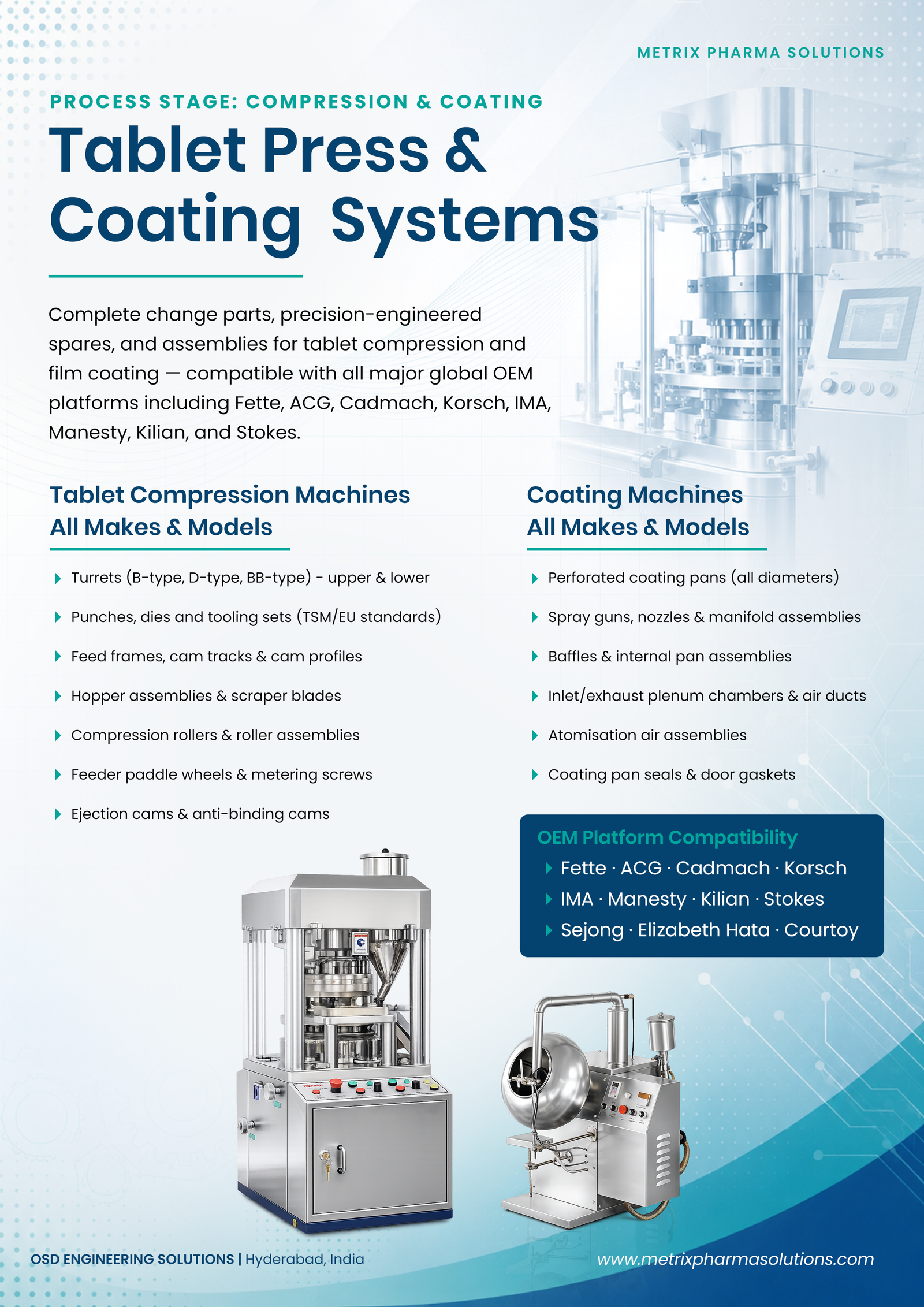
Compatible Global OEM Machinery Platforms
Metrix manufactures direct drop-in replacement components and rebuild kits compatible with:
1. Anatomy of High-Speed Tablet Press Turrets & Tooling Configurations
In solid dosage manufacturing facilities, the rotary tablet press represents the core of tablet manufacturing productivity. The turret assembly is the heart of every rotary tablet machine, dictating punch stroke precision, dwell time, pitch circle diameter (PCD), and ejection dynamics. Tooling configurations conform predominantly to international standards: TSM (Tablet Specification Manual) in North America and EU (Euronorm) standards globally.
Tooling selections directly govern compression capabilities:
- B-Type Tooling: Punch barrel diameter of 0.750 in (19.05 mm), outer die diameter of 1.1875 in (30.16 mm). Suited for maximum turret station count (e.g., 36 to 55 stations) to deliver massive hourly output (up to 300,000+ tablets/hour) for standard small-to-medium tablets.
- D-Type Tooling: Punch barrel diameter of 1.000 in (25.4 mm), outer die diameter of 1.500 in (38.1 mm). Built to withstand high pre-compression and main compression loads (up to 100 kN), necessary for large effervescent formulations, veterinary boluses, and high-density nutraceuticals.
- BB-Type & Special Tooling: Utilizing B punch barrels with reduced outer diameter dies, maximizing punch count for multi-station operations.
2. Common Turret Failure Modes & Punch Bore Degradation
Even premium tablet presses from Cadmach, Fette, ACG, Korsch, and Manesty suffer wear over continuous manufacturing cycles. Granulate fines, abrasive APIs, and uncalibrated punch lubrication introduce several progressive wear mechanics:
- Punch Bore Bell-Mouthing: Angular deflection of punch barrels during compression causes localized ovality and bell-mouthing at bore mouths, leading to punch misalignment and weight variation.
- Cam Track Galling: Upper and lower cam tracks (pull-down cams, raising cams, ejection cams) suffer frictional scarring when lubrication fails or scraper blades bypass formulation dust.
- Die Pocket Fretting: Repeated insertion and removal of dies without proper anti-seize torque protocols cause microscopic fret corrosion in the turret ring die pockets.
3. Precision Reverse Engineering & Manufacturing Standards
At Metrix Pharma Solutions, we engineer replacement turrets, upper/lower cam tracks, feeder frames, and scraper blades using state-of-the-art coordinate measuring machines (CMM) and CNC machining centers in Hyderabad. Every component is machined from vacuum-degassed tool steels (AISI D2, 440C stainless, or alloy steels with nickel-phosphorus coatings) ensuring:
- Pitch Circle Diameter (PCD) runout tolerance held within ±0.005 mm.
- Mirror surface finishes certified to Ra ≤ 0.4 µm on all product-contact areas.
- Complete Material of Construction (MOC) mill test certification and dimensional inspection sign-offs.
Explore Related OSD Engineering Guides:
Frequently Asked Technical Questions (AEO Q&A)
Q1: What is the primary operational difference between B-type, D-type, and BB-type tablet press tooling?
B-type tooling features a punch barrel diameter of 0.750 inches (19.05 mm) and die diameter of 1.1875 inches (30.16 mm), optimized for medium tablets with higher punch count turrets. D-type tooling has a 1.000-inch (25.4 mm) punch barrel and 1.500-inch (38.1 mm) die diameter, delivering higher compressive force capacity (up to 100 kN) for large diameter tablets. BB-type utilizes B punch barrels with smaller dies for high-capacity multi-station operations.
Q2: How does Metrix Pharma Solutions ensure interchangeability with OEM presses like Fette, ACG, and Cadmach?
Our engineering lab utilizes coordinate measuring machines (CMM) and reverse-engineering precision scanning to replicate exact OEM pitch circle diameters (PCD), cam track angles, keyway orientations, and hardened tool-steel metallurgy (AISI O1, D2, and 440C stainless) with Ra <= 0.4um micro-finishes.
Q3: What causes tablet punch tight bore and how does it compromise production?
Punch bore binding occurs when granulate fines penetrate clearances between punch barrels and turret bores, caused by inadequate lubrication, formulation abrasiveness, or thermal expansion. This leads to cam track gouging, erratic tablet weight variation, and severe punch head distress.
Q4: Can Metrix supply customized feed frames and anti-binding cam tracks?
Yes. Metrix designs forced mechanical feeder assemblies, zero-clearance scraper blades, and variable-speed paddle wheels with anti-binding cam geometries specifically designed to prevent powder bridging and formulation leakage.
Authored by Metrix Pharma Solutions Engineering Division
Based in Miyapur, Hyderabad, our team brings decades of cumulative experience in mechanical fabrication, precision punch tooling, fluid bed engineering, and validated pharmaceutical automation.
Verified for compliance with cGMP, US FDA 21 CFR Part 11, and ASME BPE guidelines.